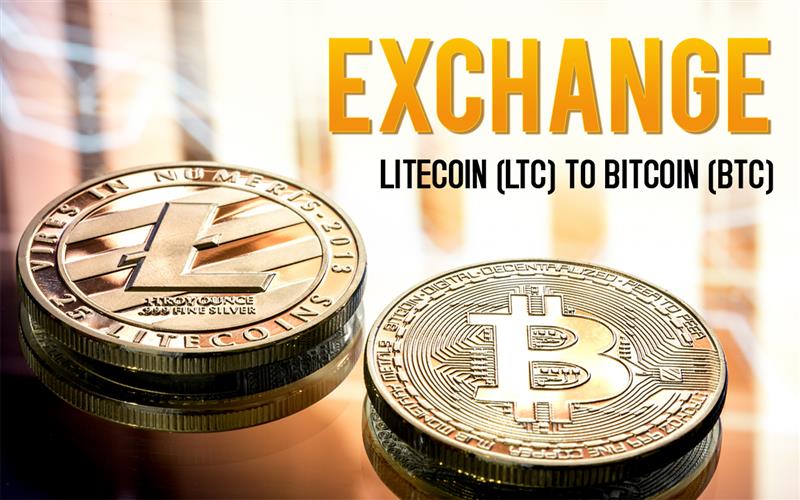

Bitcoin (BTC) to Litecoin (LTC) exchanges are popular among users who value not just owning cryptocurrency but also using it effectively for transfers and payments. Bitcoin remains the market’s primary asset, but its network isn’t always suitable for fast and frequent transactions. In such cases, Litecoin (LTC) becomes a practical alternative.
Litecoin was created as a faster version of Bitcoin. It retains a similar architecture but offers shorter block confirmation times and lower fees. Therefore, exchanging BTC for LTC is often used to adapt funds for active transactions without going beyond proven and well-understood technologies.
Why Litecoin is convenient for practical transactions
BTC serves well as a store of value, but its use in everyday transfers can be inefficient. High network load and fees make small transactions less convenient. Litecoin solves this problem. After exchanging Bitcoin for LTC, users receive an asset that is easier to use for transferring funds between wallets and services. At the same time, its architectural similarity to Bitcoin lowers the technical barrier, making Litecoin understandable even for those who have previously only worked with Bitcoin.
Exchanging BTC for LTC is relevant in the following situations:
- the need to speed up transfers;
- reducing commission costs;
- as an intermediate step before further exchanges;
- regular transactions between services;
- using cryptocurrency for settlements.
As a result, Litecoin is becoming an optimization tool rather than an alternative to Bitcoin.
How does exchanging BTC for LTC via electronic exchangers work?
First, you need to choose an electronic exchange service. It’s convenient to do this through the Bestchange aggregator. The platform contains services that have already been vetted based on various parameters. Next, you need to go to the selected exchanger.
Working with the exchange begins by selecting the desired currency pair in the service interface. After entering the amount of Bitcoin, the system instantly calculates the total amount of Litecoin that will be received upon completion of the transaction. This allows you to understand the exchange result in advance and avoid engaging in exchange trading. The next step is to specify the Litecoin wallet address where the funds will be received. It is crucial to verify that the LTC network is used, as transferring to an unsupported blockchain will result in the permanent loss of assets.
After submitting the application, the service generates a unique address for sending Bitcoin. The user transfers BTC and waits for the transaction to be confirmed on the network. A delay at this stage is normal and is related to the operation of the Bitcoin blockchain. Once the funds are credited to the exchanger, an automatic conversion occurs, after which the Litecoin is sent to the user-specified wallet. Thanks to the faster transaction processing time on the LTC network, funds are usually received without significant delays, within a few minutes.
Why choose electronic exchanges for exchanging BTC for LTC:
- no need to process orders;
- rate is fixed until funds are sent;
- minimal user involvement in technical steps;
- direct transfer of LTC to the user’s personal wallet;
- convenient operation across different blockchain networks.
It’s important to consider Bitcoin network fees and carefully check your Litecoin wallet address before sending funds. It’s a good idea to save your request information until the transaction is complete. When using the service or performing an exchange for the first time, it’s recommended to start with a small amount to ensure the platform is working correctly.
Exchanging Bitcoin for Litecoin is suitable for users looking to speed up payments and reduce costs in their everyday use of cryptocurrency. Electronic exchangers simplify this process, allowing you to quickly transfer funds from the underlying asset to a more practical format without unnecessary steps or complex procedures.